
When winter storms strike, every second counts. Whether you’re servicing a campus, mall, municipal lot, or commercial complex, the ability to pre-load, deploy, and precisely apply salt without relying entirely on salt trucks can make or break your operation. That’s where Virnig’s modular Salt Spreader steps in — engineered to eliminate inefficiencies, reduce waste, and simplify logistics.
What It Is & Why It Matters
Virnig’s salt spreader is designed to let snow removal contractors and property managers preload, store, and apply salt using a scalable, modular system. It aims to reduce reliance on large salt trucks during storms, so you can get material on the ground faster, with fewer passes and less labor.
Key features include:
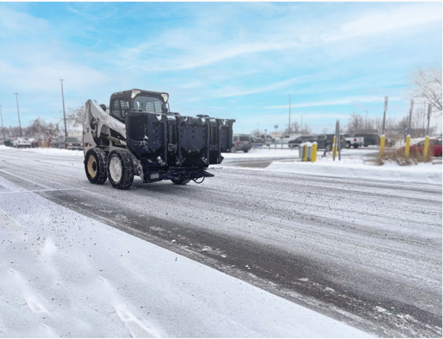
- Dual spinners that broadcast material to both sides for an even spread, minimizing overlaps and wasted salt
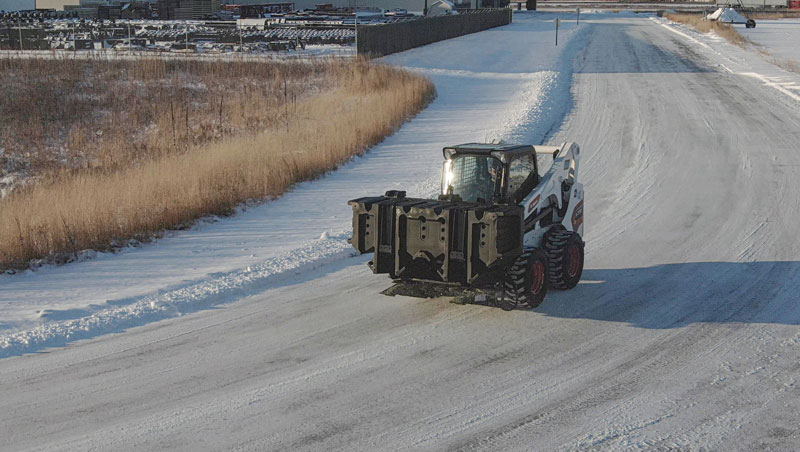
- Front-mounted configuration, giving the operator better visibility and control in tight or high-traffic zones
- Nickel-plated motor shaft, resisting corrosion and improving longevity in salty, wet environments
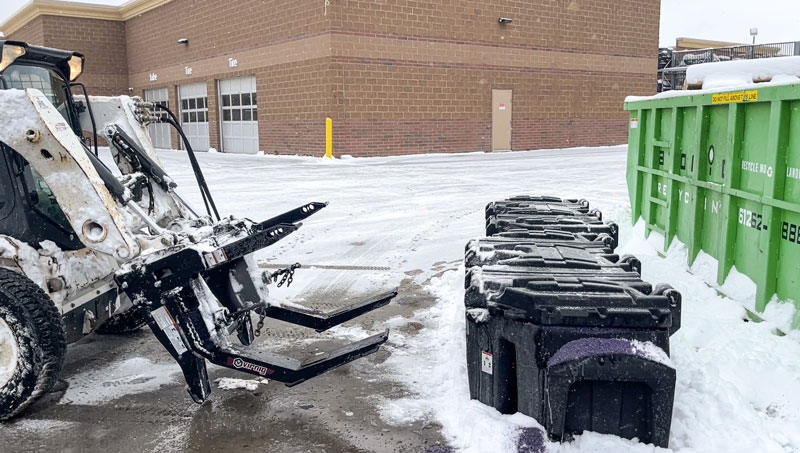
- Stackable, lockable poly totes (0.75 cubic yard each) that keep your salt dry, secure, and easy to handle
- Dual augers with chain agitation, to break clumps and keep heavier materials (sand, salt blends) flowing smoothly
- Manual flow control valve, enabling adjustments in spread width from 10 ft up to 40 ft
Specs Snapshot
|
Spec |
Value |
|
Spread Width Range |
10 ft to 40 ft |
|
Tote Capacity |
0.75 cu yd / 20.25 cu ft |
|
Spinner Diameter |
13.5 in |
|
Approx. Weight (spreader only) |
~595 lbs |
|
With Empty Tote |
~900 lbs |
|
Max Load w/ Bulk Salt |
~2,520 lbs |
|
Recommended Loader Capacity |
> 2,600 lbs |
These numbers give you a ballpark for what loader class and vehicle platform you’ll need to operate the system safely and efficiently.
How It Performs in the Field
Dual Spinner Efficiency
Rather than relying on a single broadcast disc, dual spinners help you cover both sides evenly — reducing the number of passes needed and improving consistency. If you’re working around curbs, medians, or sidewalks, that even distribution can save time and reduce “miss zones.” Virnig emphasizes this as a key benefit.
Spread Adjustability & Control
Operators can tweak the spread width and flow on the fly. The factory settings default to about 15 ft in each direction, but by adjusting hydraulic flow or using the built-in valve, you can shrink that down (useful in tighter corridors or less aggressive treatment).
Also worth noting: spread rates vary with travel speed and auger option. For example, at 5 mph, the “SaltSaver” auger yields about 500 lb/acre, while the “MaxCover” auger jumps that to ~800 lb/acre.
Handling Sand & Blends
Because sand is heavier than pure salt, Virnig’s agitator chains and dual augers help maintain flow and reduce clumping. Their system handles salt-sand blends nearly as smoothly as straight salt.
Durability & Cold-Weather Use
- The poly totes are rated for cold climates and resist cracking under freeze-thaw cycles.
- The nickel-plated shaft helps prevent corrosion in harsh winter conditions.
- As with any salt-handling equipment, periodic cleaning and washing are key to preventing corrosion on the host machine.
Choosing the Right Auger: SaltSaver vs. MaxCover
One of the more asked questions is which auger to choose. The decision largely depends on your operational style:
- SaltSaver: lower application rates, ideal for pretreatment or fine-tuned use when you don’t want to overapply. At moderate speeds, you can still step up material flow without physically changing augers.
- MaxCover: handles heavier applications, suited for de-icing tasks or when you need a higher delivery rate. If your routes demand heavier coverage, this is the safer route.
If you run mixed tasks (pretreat + deice), many users choose SaltSaver for flexibility, then adjust speed or valve settings when heavier output is required.
Frequently Asked Questions (that matter)
Q: Will wet, clumped salt be a problem?
A: The system is designed to handle some moisture or slightly damp salt. The twin augers and agitation chains help break up lumps. But extremely wet or frozen salt can clog, so avoid adding that to the totes. Regular maintenance helps.
Q: Can I operate this without damaging my skid steer?
A: Yes — proper matching matters. The spreader and full tote can exceed 2,500 lbs in load. Virnig recommends loader capacity > 2,600 lbs to maintain margin.
Q: Is the mounting easy?
A: Virnig uses the ISO 24410 / SAE J2513 universal mount for standard skid steer compatibility.
Q: How about warranty and parts?
A: Virnig offers a one-year warranty on parts and attachments. Dealers typically stock common parts for quicker turnaround.
Real-World Use Cases & Tips
- Commercial / Campus Plowing: Preload your salt totes before the storm and position them strategically. When snow arrives, deploy immediately without waiting on salt trucks.
- Tight Spots & Pedestrian Zones: Because of its front-mounted design and adjustable spread, this system shines in constrained zones like plazas, sidewalks, or narrow lots.
- Gradual Salt Economy: Use SaltSaver for pretreatment (thin coverage), then bump your speed or flow when heavier deicing is needed.
- Routine Cleaning: After each shift, rinse salt residue from machine parts. Prevent corrosion and ensure the next day’s operation is trouble-free.
What to Ask Your Sales Rep
- What loader class is ideal given the total loaded weight?
- Can I demo spreading with my salt or sand blend?
- What spare parts are readily available?
- What’s the lead time for additional totes?
- Can I get onboard sensors or telematics to monitor spread rates live?
For more information visit their website.
Want more information on this?